
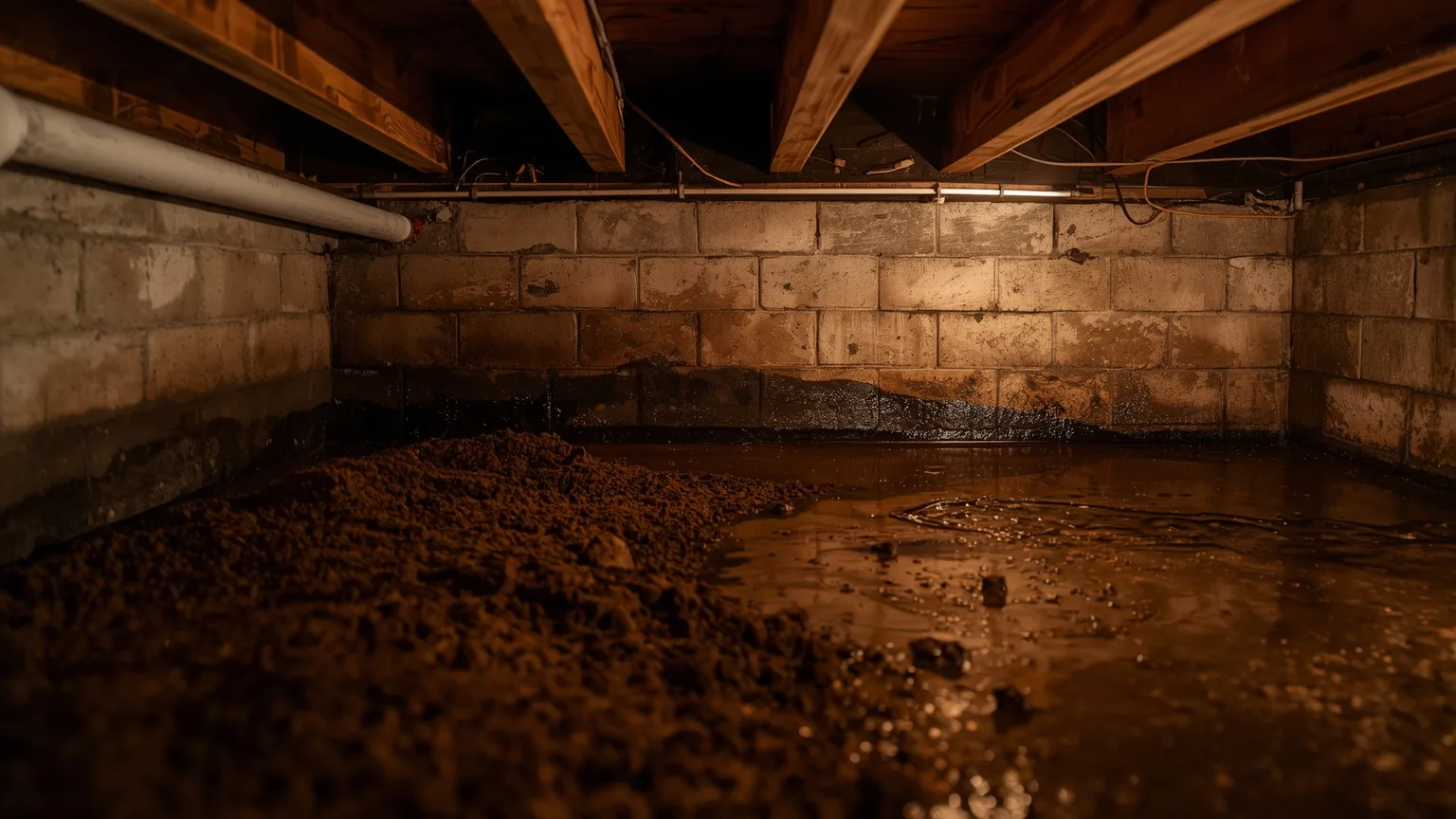
Water under a house arrives by one of three routes, and the timing usually tells you which one you have. Getting that right is the difference between a cheap fix and an expensive one.
What causes standing water in a crawl space?
Three sources: surface runoff that is not carried away from the house, groundwater moving laterally through the soil to the footing, and plumbing — a supply leak, failed waste line or HVAC condensate line discharging underneath. Each calls for different work, and the wrong diagnosis is expensive.
How do I tell which one it is?
Timing separates them more reliably than anything else you can observe.
- Within an hour or two of rain, then receding. Surface runoff. Gutters, downspouts and grading.
- A day or more after rain, or during a wet spell with no storm. Groundwater arriving on its own schedule.
- Independent of weather entirely. Plumbing. A crawl space wet in a dry August is not being wet by rain.
Why does surface water get checked first?
Because it is common and cheap to correct. Gutters discharging at the foundation, downspouts ending at the wall and grading that has settled back toward the house account for a large share of wet crawl spaces, and all three cost a fraction of interior work.
A proposal that goes straight to an interior drainage system without anyone having walked the outside of the house has skipped the step that might have solved it for far less. Ask what was found out there.
Why does groundwater arrive late?
Because it travels through soil rather than across the surface, and the soils here do not part with water quickly. The USDA classes the saturated hydraulic conductivity of the Enon series — described from a type location one mile southwest of Greensboro — as moderately low.
Water arriving faster than the ground can absorb it moves sideways instead, following construction fill lines and footings. That takes time, which is why the crawl space can flood on a clear day two days after the storm that caused it.
Why can my neighbor be dry when I am not?
Because position matters more than proximity. Guilford County runs from roughly 700 feet along the lower drainages to over 1,000 feet on the ridges, and how a particular lot was cut and filled during construction changes where water travels once it is moving laterally.
Two houses on the same street can sit very differently in that pattern. It is the main reason a neighbor's diagnosis is a poor guide to your own.
What gets done about it?
Surface causes first, because they are cheap. Where water genuinely arrives through the ground, interior drainage collects it and a sump system routes it clear of the foundation.
North Carolina code is specific here: the closed crawl space floor must be graded to one or more low spots with a drain to daylight or a sump pump at each, and those drains must be kept separate from roof gutter drains and foundation perimeter drains. Only once water has a route out does sealing make sense.