
Crawl space problems rarely announce themselves from underneath. They show up in the rooms above, in ways that are easy to attribute to something else.
What are the signs of a crawl space moisture problem?
The common ones are a musty smell on the ground floor, floors that feel springy or have started to slope, insulation hanging down between joists, visible condensation on ducts or pipes in summer, and growth on the subfloor. Any one of them justifies a look underneath.
Why does a musty smell upstairs point downward?
Because air travels upward through a house. Warm air rising and escaping at the top draws replacement air in at the bottom, and in a house over a crawl space a real share of that replacement air comes from the crawl space itself.
That is why an odor that cleaning does not shift, and that is stronger on the lowest floor or near floor registers, is worth tracing downward rather than treating at the surface.
What do springy or sloping floors actually mean?
They mean framing has lost stiffness or a support has moved. Floor structure is sized to be stiff, not merely strong enough not to break, so give underfoot is a meaningful change rather than a cosmetic one.
The pattern narrows the cause. Bounce across a broad area suggests joists or girder support. A localized dip suggests one pier or post. Doors that stop latching square suggest movement that has been progressing for a while. None of it is diagnosable from the room above, which is why the inspection happens underneath.
Why is insulation falling down?
Because it has taken on moisture. Fiberglass batts hold themselves against the subfloor with friction and whatever supports were installed. Add moisture and they get heavier, lose loft and start to sag away.
Once a batt is hanging rather than in contact, it has stopped insulating and become a damp mass held against wood. Replacing it without changing the conditions produces the same outcome on the same timeline.
Why does condensation appear on ducts and pipes in summer?
This is the mechanism happening where you can see it. Warm air carries far more moisture than cool air, and outdoor humidity in Greensboro peaks around 76 percent in August. When that air enters through the vents and meets a surface below its dew point, the moisture leaves the air and lands on the surface as liquid water.
Ductwork and water lines are usually the coolest surfaces down there, so they bead first. It is worth understanding that the vents were supposed to dry the space and in this climate they are what delivers the water.
When is it worth having someone look?
When any of the above is present, and particularly when more than one is. The underlying conditions do not resolve on their own, and wood becomes able to support fungal growth at around 20 percent moisture content — it is sustained time above that threshold, not any single humid week, that does the damage.
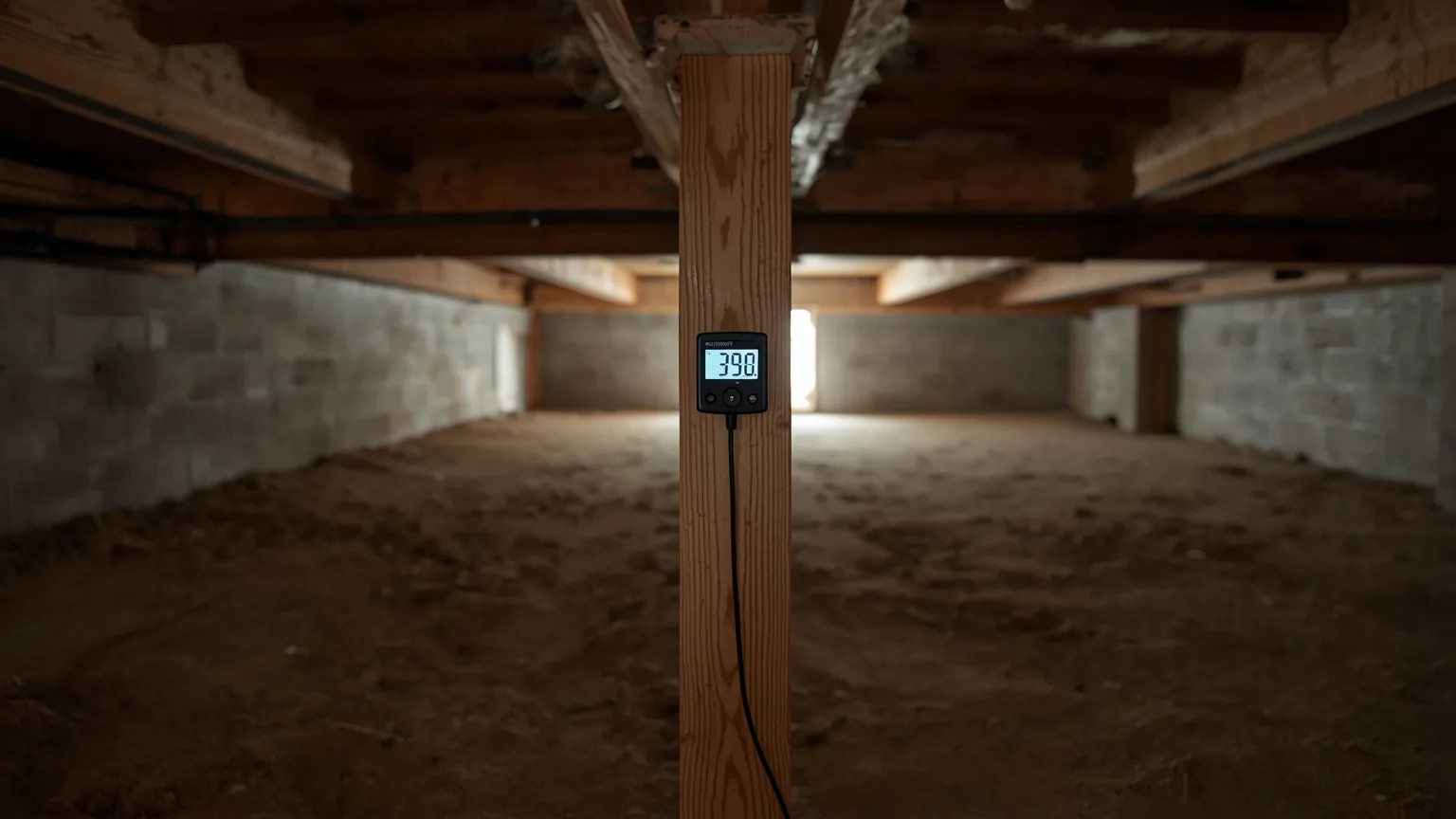
An evaluation should include moisture readings taken in the framing in more than one place. If nobody measured anything, what you have is an opinion. Our page on crawl space moisture control covers how the three possible sources are told apart.