
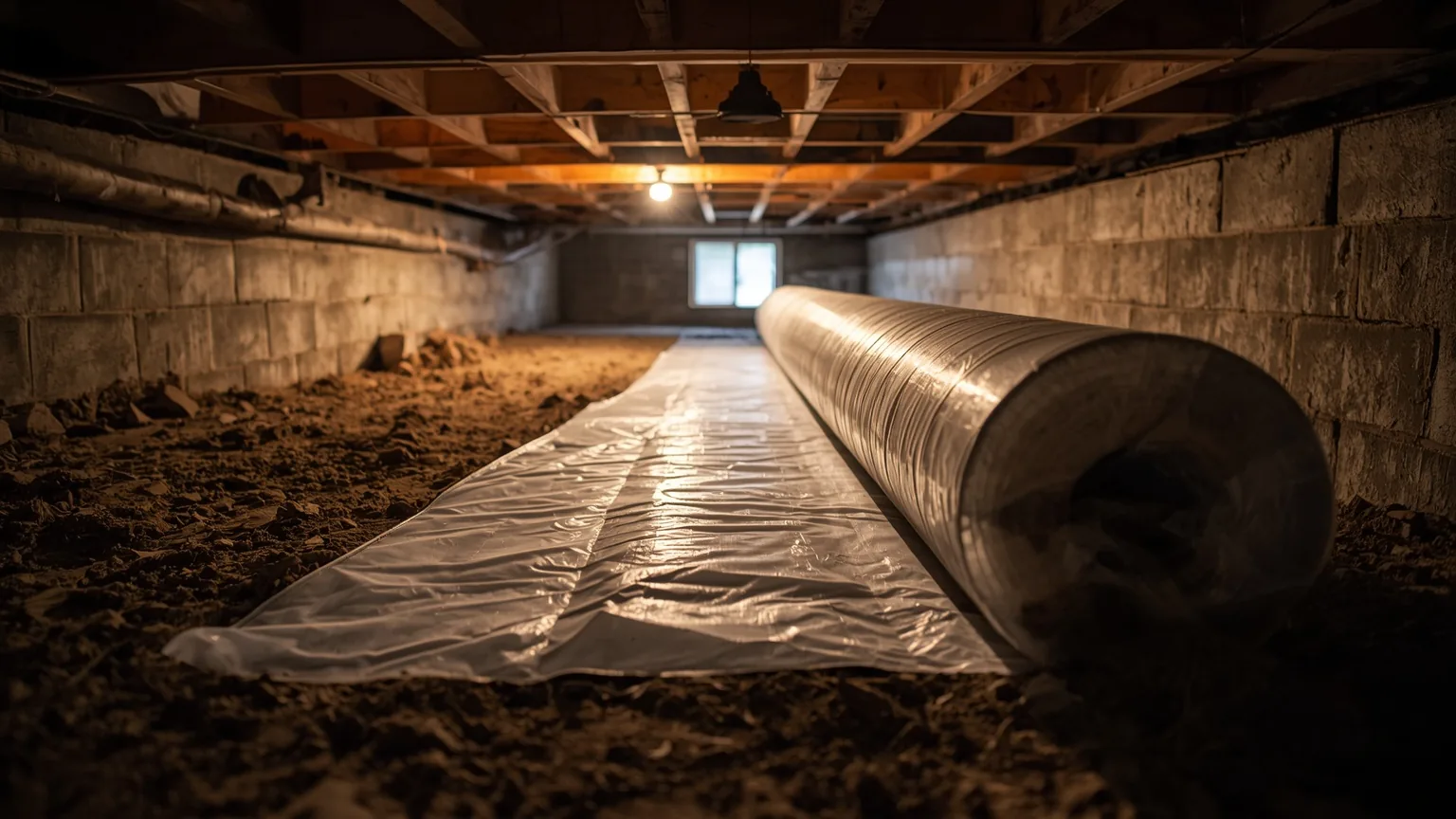
These two words get used as if they mean the same thing, and the price difference between them is large enough that the confusion costs real money. They are not the same job.
What is the difference between a vapor barrier and encapsulation?
A vapor barrier is sheeting laid over the exposed earth so soil moisture cannot evaporate upward. Encapsulation includes that barrier but adds sealing the vents and rim joists, carrying liner up the foundation walls, and actively drying the air that remains. The barrier is one component of the larger job.
What does a vapor barrier actually do?
It interrupts one moisture source: the ground. Exposed soil under a house gives off moisture continuously, whether or not there is standing water on it, and that moisture goes into the air, into the framing, and partly into the rooms above.
North Carolina sets a floor for this. Residential Code R409.2.1 requires a minimum 6-mil polyethylene vapor retarder or equivalent covering all exposed earth, with joints lapped not less than 12 inches. That is the published minimum rather than a premium specification, which gives you something concrete to hold an estimate to.
What does encapsulation add on top of that?
Three things the barrier does not do. It seals the vents, so humid outside air stops entering. It air-seals the rim joist, closing the gap where the framing meets the foundation. And it adds a mechanical means of drying, because sealing the space removes the air exchange that used to carry some moisture away.
Liner is also normally carried up the foundation walls and fastened, rather than stopping at the edge of the dirt.
When is a vapor barrier alone enough?
When the ground is the dominant moisture source and the space is otherwise sound. If framing reads in a normal moisture range, there is no standing water, no condensation staining and no odor reaching the rooms above, ground cover may be the whole job.
That is a real outcome and worth asking about, because it costs considerably less. Be wary of anyone who reaches an encapsulation recommendation without having taken a reading.
When does a barrier fall short?
Against humid air. In a Piedmont summer the outdoor air carries more moisture than the crawl space can hold at its own temperature, and when it comes through the vents it condenses on whatever is coolest — ductwork, water lines, the underside of the subfloor.
Ground cover does nothing about moisture arriving that way, because it is not coming from the ground. This is the single most common reason a homeowner installs a barrier, sees no improvement, and concludes the work was done badly when in fact it was the wrong work.
| Moisture source | Vapor barrier | Full encapsulation |
|---|---|---|
| Evaporation from bare soil | Addressed | Addressed |
| Humid air through open vents | Not addressed | Addressed |
| Liquid water entering | Not addressed | Not addressed — needs drainage first |
| Ongoing humidity control | None | Mechanical drying required |
| Relative cost | Lower | Higher |
How do you tell which one your house needs?
By measuring rather than guessing. Moisture readings taken in the framing in several places, plus relative humidity in the space, separate a ground-vapor problem from an air problem. Timing helps too: damp that peaks in still, hot weather points at air, while damp worst on exposed soil points at the ground.
Our pages on vapor barrier installation and crawl space encapsulation go further into what each scope includes.